SEO vs Social Media for Small Businesses: What Should You Focus on First?
What should you do as a growing business, when your time and budget is limited, but you still want to maximise your impact and marketing reach?
One of the most common questions I hear is: should I focus on SEO or social media first?
If you’re trying to decide between SEO vs social media as a small business in the UK, this guide will help you understand the differences and opportunities, and where your efforts are best spent.
Social or SEO first?
Should you invest your time and money into improving your website’s visibility and engagement through SEO and GEO? Or should you focus on reaching your clients through social channels, directing them to your site and your offers from there?
Of course, the ideal thing would be to do both. BUT budgets being what they are, I fully understand the need to just do the next right thing and take it from there.
Let’s take a look at what you get out of both these and which is going to be the best option for you right now.
What is SEO and what does it actually do for small businesses?
Search Engine Optimisation does what it says on the tin - it optimises your search engine visibility. Put simply: SEO helps people find you online.
Using keywords and content, an effective SEO strategy will help people find you through Google. Google’s ‘bots’ crawl through all the pages of all the websites they can find and they look for features that show that the content is of a good quality and ranks it according to the relevance for each particular search term.
Ever wondered why some of your competitors appear way above you on the search page, even if they’re not in a featured (paid) spot? It’s because Google has ranked them higher in terms of relevance, most likely due to a stronger performance on the keywords that best reflect what your clients are looking for.
Hang on, isn’t is all about AI now though?
What about AI search and GEO (Generative Engine Optimisation)?
Search is evolving quickly, and it’s no longer just about ranking on Google.
More and more people are now using AI tools like ChatGPT or Google’s AI-powered search results to ask questions and get recommendations. Instead of just showing a list of websites, these tools often generate answers and pull information from trusted, well-optimised content.
This is where GEO (Generative Engine Optimisation) comes in.
GEO is about making sure your content is clear and easy to understand, genuinely helpful and informative and structured in a way that AI tools can interpret and reuse
In many ways, it overlaps with good SEO, but places more emphasis on answering real questions (that someone might type into an AI text box), and demonstrating expertise and trust in a natural, conversational tone.
In simple terms:
SEO helps you rank in search results, while GEO helps your content get used in AI-generated answers.
Pros of SEO (including GEO)
Builds long-term, consistent website traffic
The people who find your website this way will already have a level of intention: they’ve just searched for a service like yours!
Increases your visibility in both traditional and AI-powered search
Strengthens your credibility and authority
Cons of SEO
Takes time to build momentum
Requires a website and some upfront effort
Results aren’t immediate so patience is required
What is social media marketing and what is it good for?
Yeah yeah, we all know what social media is! But before I gloss over that, it’s important to bear in mind that different platforms suit different things. You can’t simply chuck up a Facebook profile and hope for the best. Choosing the right platforms to showcase your business will form a key part of your marketing strategy.
Use it to build awareness and trust.
Think about your likely clients and research the demographics and content styles of each of the platforms to find your niche:
Do you run a beautiful countryside pub aiming to draw in a younger, foodie crowd? > Aspirational posts on Instagram and compelling content on TikTok will serve you better than pithy posting on Twitter and LinkedIn.
A gardening centre looking to expand your attraction across the generations? > A mix of gardening content on Facebook and fun tips on Instagram and TikTok will reach a combination of established and new gardeners.
Use social media to give your brand a depth of personality and to highlight your unique proposition. This is a medium where you can have a bit of fun - simply outlining your offering isn’t going to result in all that much engagement. Think about the people you meet at a party. Are you more likely to want to spend time with the people who only talk about themselves? Or the ones who seek connection, who talk about common interests and create a fun buzz?
There’s never going to be the one social post that clicks for all your marketing for ever more and that you’ll be able to say ‘yes, this is the one that resulted in twenty three enquiries and twelve sales.’ It’s more about the continued connection you can create with your audience of potential customers.
Added to that, you’ll be able to take advantage of the platform’s ability to push content to extended audiences that it knows are interested in accounts like yours.
Pros of social media marketing
Quick to start
Builds connection with your audience
Great for visibility and helping people find you
Cons of social media marketing
Low buying intent from your audience
Requires consistency
Algorithm-dependent
The Key Differences
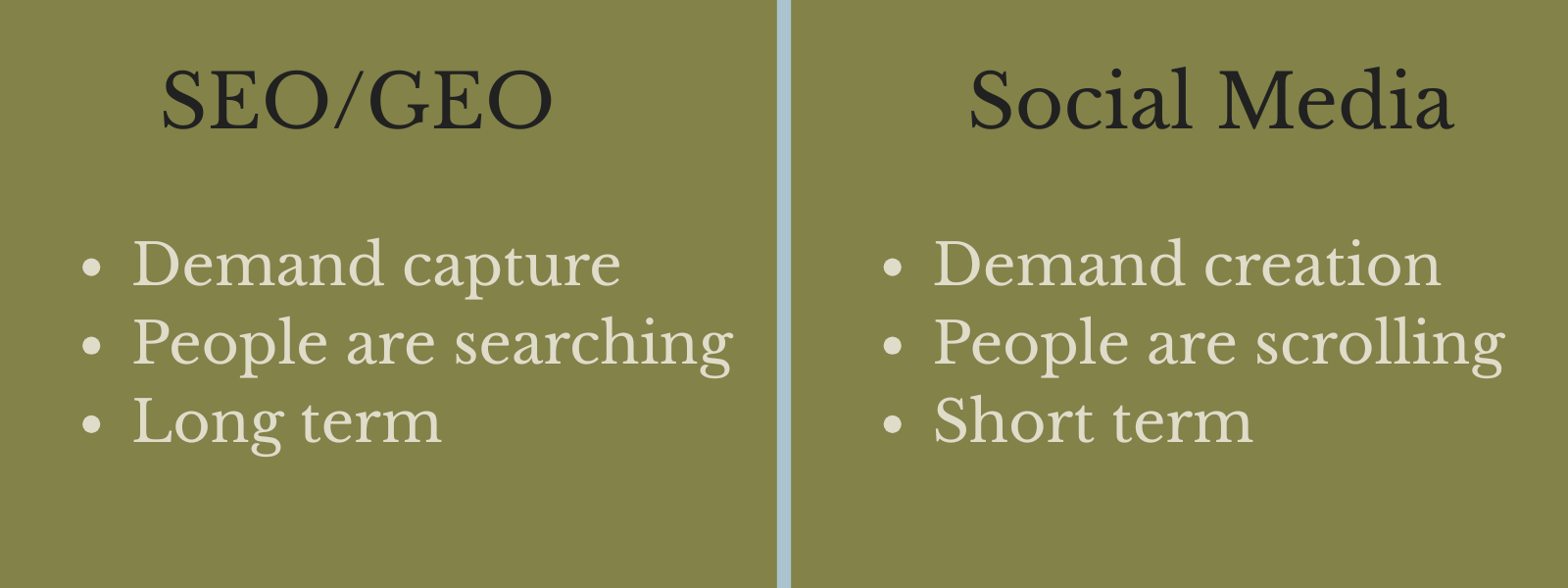
When comparing SEO vs social media for small businesses, the key difference comes down to how customers find you:
Social media helps people discover you. SEO helps people find you when they’re ready.
Great, but you still haven’t told me which I should focus on first!
As with all marketing, there isn’t any one-size-fits-all solution to this. However, we can broadly break it down.
Start with SEO if:
You have, or want to create, a website
There are people already searching for your service online
You want consistent enquiries
You’re a local or service-based business
Start with Social Media if:
You don’t have a website or any immediate plans to create one (I think you should, but that’s a conversation for another time!)
Your service is visual or personality-driven
You’re building a brand from scratch
You need quick visibility
A (very simple) marketing plan for small businesses
Start with the SEO basic foundations to bolster your website’s search prominence and use social media to support your visibility and drive traffic to your website. Your website should be your foundation, with social media supporting it - not the other way round.
Here’s a simple plan of action:
Week 1 and 2
Set up your website basics
Add your core service and contact pages
Week 3 and 4
Implement your basic SEO and GEO work (keywords, page titles, copy)
Ongoing
Post on social media in line with your strategy - usually 3-4 times a week depending on your chosen platform
Make sure you’re driving traffic to your website with clear calls to action in your posts
Not sure what’s right for your business?
Every business is unique and so is their ideal marketing strategy. If you’d like some clarity on where to focus your time and budget, I can help you map out a simple and effective plan! Get in touch with me to hatch a plan.